For copper pipe connections, compression fittings provide a dependable way to join tubing without soldering or using torch heat. A Copper Compression Union works with a body, ferrule, and nut, and the seal is formed when the nut is secured with a wrench. Because of that simple design, the Compression Fitting 3/4 and 3/4 Copper Compression Fitting are often chosen by professional plumbers and hands-on homeowners.
3 4 Compression Fittings
These unions are versatile, suitable for both residential and commercial projects, including water lines and instrumentation. Installation Parts Supply often carries 3/4 Compression Fitting Copper and 3 4 Compression Fittings in materials such as brass, copper, and stainless steel. The ferrule deforms between the tapered nut and body, effectively sealing tubing such as annealed copper or compatible thermoplastics.
Key Takeaways
- Copper Compression Union couples copper pipe without soldering.
- Compression Fitting 3/4 and 3/4 Copper Compression Fitting are common sizes.
- 3/4 Compression Fitting Copper and 3 4 Compression Fittings are often available through Installation Parts Supply.
- Brass bodies and ferrules deliver strength and corrosion resistance.
- Wrench-tightening the nut drives the ferrule to form a leak-tight seal.
Understanding Copper Compression Union Design And Components
The Copper Compression Union is a three-piece design that couples tubing without soldering. It is widely used in plumbing, HVAC, refrigeration, gas distribution, and instrumentation. This is because it delivers a tight, compressive seal. The 3 4 Copper Compression Union is commonly used in residential and light commercial settings.
Copper Compression Union Uses And Basics
A compression union links two tube ends by seating a ring around the pipe as the nut is tightened. It is often chosen for quick repairs, service loops, and confined spaces where torch work is impractical. The 3/4 Copper Compression Fitting is well suited for common mains, branch lines, and appliance feeds without brazing.
Parts Of A Compression Union: Body, Ferrule Olive, And Nut
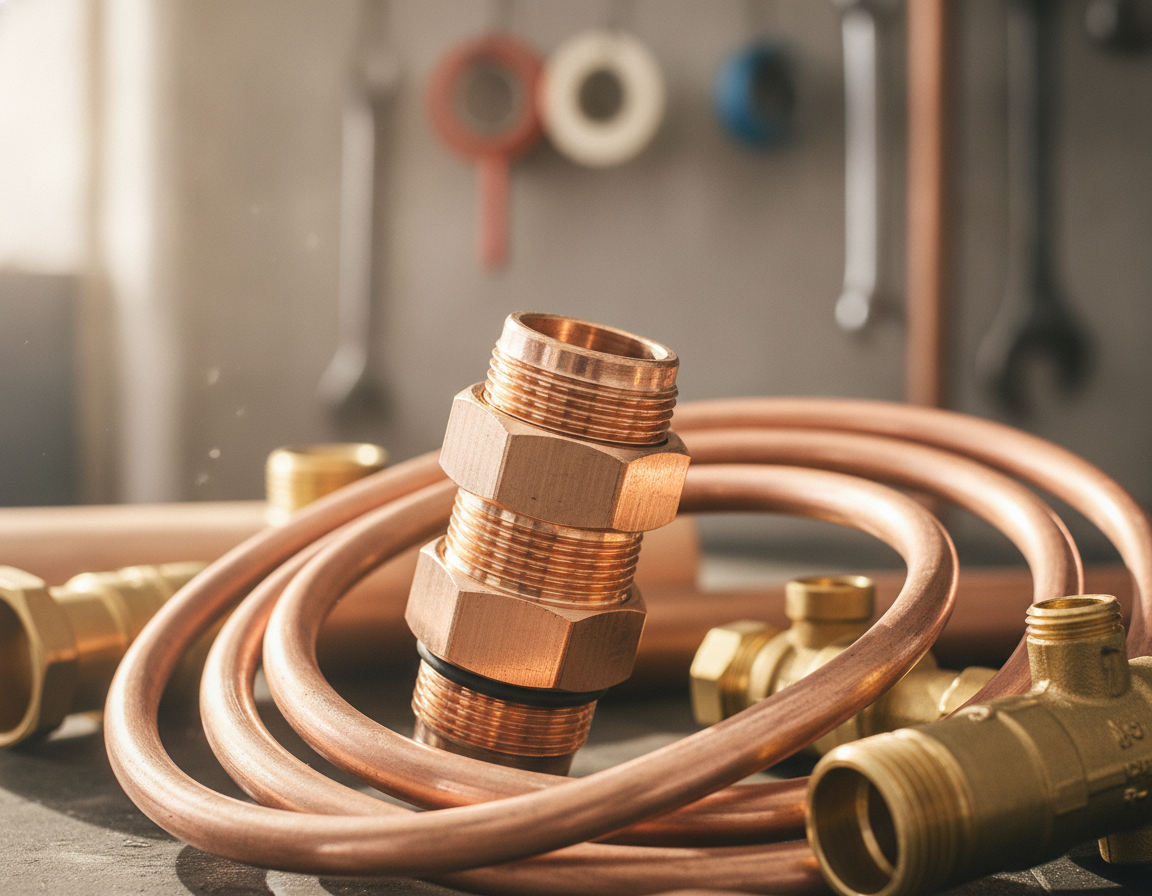
The union body provides the threaded section that receives the nut. The ferrule, often called an olive, compresses and seals against the pipe and body when the nut is drawn up. The nut threads onto the body and creates the compressive force. Correct ferrule seating is necessary for a leak-free joint and dependable field serviceability.
Materials Used With Copper Unions: Copper, Brass, Stainless Steel, And Plastics
Brass unions are slightly forgiving and corrosion-resistant, which makes them a reliable match for copper pipe in water and gas systems. Stainless steel adds extra strength for high-pressure or high-temperature systems. Copper-to-copper unions maintain similar thermal expansion and fit common tubing sizes. Plastic ferrules and fittings, like acetal or nylon, are used in low-pressure domestic systems where chemical resistance and nonmetallic connections are desired.
Why Copper-To-Copper Unions Reduce Galvanic Corrosion Risk
When metals match, galvanic corrosion risk decreases because similar alloys share electrochemical properties. A copper-to-copper union, or a brass body paired with copper pipe, lowers active corrosion at the connection. When using a 3/4 Compression Fitting Copper, avoid direct contact between copper and carbon steel or other dissimilar metals unless dielectric breaks are used for long-term durability.
Benefits Of Compression Fittings For Copper Pipes
Compression fittings offer a convenient, safe alternative to soldered joints for copper pipes. They eliminate the need for an open flame, reducing fire risks near insulation, drywall, or aging structures. A Compression Fitting 3/4 can create a dependable seal without heat, making it practical for retrofits and tight locations.
Installation is usually simple across many fitting brands. First, slide the nut and then the ferrule. Next, insert the tube fully and hand-tighten before a final wrench turn. A 3/4 Compression Fitting or 3 4 Compression Fitting can be assembled quickly in crawl spaces, behind cabinets, or other tight areas where torch work is not practical.
Serviceability is one of the main advantages of compression unions. Many tradespeople use 3 4 Compression Fittings because assemblies can be loosened or repositioned without cutting pipe. Ferrules may need replacement after disassembly, yet the overall joint often remains reusable, saving time during repairs and modifications.
Compression fittings are suitable for a wide range of systems beyond household plumbing. They are used in gas distribution, HVAC refrigeration lines, and instrumentation where leak integrity and ease of maintenance are critical. For projects requiring a compact, heat-free connection, a Compression Fitting 3/4 or 3/4 Compression Fitting delivers a practical solution.
| Comparison Point | Compression Connection | Solder Joint |
|---|---|---|
| Heat needed | No | Torch or heat needed |
| Installation speed | Fast | More time required |
| Ease of service | Often serviceable | Not serviceable without cutting |
| Suitability in confined spaces | High | Limited |
| Typical uses | Water lines, gas, HVAC, and instrumentation | Permanent water runs and sealed joints |
Choosing Size And Material For Reliable Compression Connections
A reliable plumbing joint depends on the correct size and material selection. Before making a purchase, verify the pipe’s outside diameter and the fitting’s designation. Misreading terms such as 3/4 Compression Fitting can lead to leaks, poor fit, and expensive repairs.
When selecting fittings, it is essential to understand the difference between nominal size and outside diameter OD. Look for SKU terms such as 3 4 Copper Compression Union or 3/4 Copper Compression Fitting. This helps ensure the ferrule seats correctly on your copper tubing.
Common SKU keywords to search for
Retail listings and manufacturer catalogs often list parts under different names. Choose listings with clear labeling and standard references. Common terms include Compression Fitting 3/4 and 3 4 Copper Compression Union. Ensure the product description corresponds to your pipe’s OD or nominal size.
Material selection
Brass is the favored material for copper pipe systems due to its ductility and corrosion resistance. A 3/4 Union Brass or 3 4 Union Brass is well matched for many residential and light-commercial installations.
Copper unions are well suited for matching metals, managing thermal expansion, and preventing galvanic action. A 3/4 Compression Fitting Copper provides a matching connection suited to refrigeration and conventional plumbing.
Stainless steel is selected for applications requiring higher pressure or resistance to aggressive chemicals. Compared with brass and copper, it offers higher strength and stronger chemical resistance.
Acceptable uses for plastic fittings
Acetal or nylon compression fittings are suitable for low-pressure domestic water lines and where non-conductivity is necessary. However, they have limits, including lower pressure ratings, lower temperature tolerance, and sensitivity to some chemicals.
Comparison of common coupling materials
| Material | Typical Use | Durability | Notes |
|---|---|---|---|
| Brass, including 3/4 Union Brass | Potable water, gas, general plumbing | Good | Cost-effective, compatible with copper |
| Copper 3/4 Compression Fitting Copper | Refrigeration, plumbing, and same-metal joints | Moderate | Reduces galvanic risk and matches copper tube |
| Stainless compression material | High pressure, high temp, corrosive fluids | Strong | Excellent for harsh industrial applications |
| Plastic acetal/nylon | Domestic low-pressure applications | Low-medium | Nonmetallic but limited by temperature and chemistry |
Sizing tip
When encountering product names like 3 4 Brass Compression Coupling or 3/4 Inch Compression Fitting, confirm the listing’s reference to OD or nominal pipe size. Verify compatibility against manufacturer specifications and, where relevant, approvals from trusted brands such as Dixon.
Best Installation Practices For A Leak-Free Union
Start with copper tubing that is undamaged. Utilize a pipe cutter for a precise square cut. Remove any burrs with a deburring tool or fine sandpaper. A smooth, square tube end is necessary for preventing ferrule damage and creating a reliable seal with 3/4 Compression Fittings.
Assemble components in the correct order. Place the compression nut on the pipe with threads facing outward, followed by the ferrule. Push the pipe fully into the union body until it bottoms out. This step is important to avoid gaps that can cause leaks when using a 3 4 Brass Compression Coupling or a 3/4 Compression Fitting Copper.
First, hand-tighten the nut so the parts align properly. Then use two wrenches, with one holding the fitting body steady and the other turning the nut. Follow the manufacturer’s recommended wrench turns past finger-tight. Over-tightening can deform the ferrule or crush the copper, reducing the life of a 3/4 Copper Compression Fitting.
Do not reuse ferrules after they have been compressed. Always fit a new ferrule and nut for each joint. Avoid installing compression joints in areas exposed to constant vibration or repeated movement. These conditions can loosen fittings such as 3/4 Compression Fittings and 3 4 Brass Compression Coupling over time.
Know the pressure and temperature ratings for the chosen fitting. Check product datasheets or packaging before installing. After assembly, slowly restore pressure and inspect for leaks. If minor weeping appears, tighten incrementally. If the leak continues, disassemble the joint and inspect the ferrule, nut, and pipe end to verify correct seating.
Compression Union Maintenance, Replacement, And Troubleshooting
Start by turning off the water supply and relieving system pressure. Use two wrenches to support the fitting body while turning the compression nut counter-clockwise. If the nut is seized, apply penetrating oil and allow it to soak before trying to remove it.
Safe removal of an existing compression union
Stabilize the pipe with one wrench and turn the nut with a second wrench. After the nut loosens, slide the nut and ferrule away from the tube end. If the union is old or corroded, loosen it slowly to avoid sudden leaks or pipe damage.
When to replace ferrule and nut instead of the full union
Replace the ferrule and nut when the fitting body looks sound and the sleeve shows wear or deformation. Replace the full union if the body threads are corroded, leaks continue after new ferrules are installed, or the assembly no longer meets pressure or material requirements.
Common failure signs: weeping, corrosion, or ferrule damage
Look for weeping at the nut-ferrule interface, green or white corrosion on brass or copper, and crushed or split ferrules. Vibration can loosen unions over time and lead to slow leaks.
Tips to cut out a stuck ferrule without damaging the copper pipe
Score the ferrule lengthwise with a thin rotary blade or hacksaw, then pry it open and peel it off. Use a ferrule puller if available. If the tube is nicked, flattened, or damaged, cut the end square again, deburr it, smooth it, and reinstall with a new ferrule and nut.
Compression union versus soldered joints for long-term service life
Soldered joints generally provide a more permanent seal and often last longer under static conditions. Compression unions are easier to service and require no flame, making them useful for repairs and confined spaces. In systems exposed to vibration or long-term mechanical stress, soldered joints tend to outperform compression fittings.
| Item | Serviceability | Expected Service Life | Best Use |
|---|---|---|---|
| Brass 3 4 Compression Union | Can be opened, but ferrule replacement is often needed | About 5–15 years based on service conditions | Service work, confined spaces, and flame-free jobs |
| 3/4 Union Brass | Moderate; replace nut and ferrule if body is intact | Often 5–15 years under normal use | Plumbing runs that may need future service |
| 3/4 compression connector | Limited reuse possible, but ferrules should be replaced after cycles | Varies by material; brass commonly 7–20 years | Fast no-solder repairs and installations |
| 3/4 Inch Compression Fitting | Simple to install, though ferrule reuse should be avoided | Varies by conditions and may shorten under movement | Home plumbing and retrofit repairs |
| Soldered comparison for 3/4 Compression Fittings | Soldered joints are permanent and not easily serviced | Often 20+ years with proper installation | Long-term fixed runs and vibration-prone systems |
When sourcing spares, check manufacturers such as Mueller, Nibco, or Watts for compatible 3/4 Compression Fittings and 3/4 Inch Compression Fitting parts. Before reinstalling any replacement ferrule or nut, always confirm material compatibility and pressure ratings.
Conclusion
Copper compression unions deliver a practical solution for joining copper tubing without the need for soldering. The union’s body, ferrule, and nut form a tight seal when properly sized and installed. That makes them useful where heat is impractical or where future serviceability matters.
When selecting materials, consider the application: brass or copper for potable systems to minimize galvanic risk, stainless steel for harsh or high-stress environments, and approved plastics where allowed. A 3/4 Compression Fitting or a 3/4 Copper Compression Fitting will work well if the pipe is cut square, the ferrule is correctly seated, and tightening follows the manufacturer’s guidelines.
Maintenance is straightforward: inspect for weeping or corrosion, replace ferrules when needed, and avoid overtightening to extend union life. For parts such as a 3 4 Copper Compression Union or 3 4 Union Brass, confirm availability and specifications through Installation Parts Supply. This helps ensure compatibility, proper sizing, and correct installation guidance.
Related: The Steps to Install a 3 4 Copper Compression Union Correctly